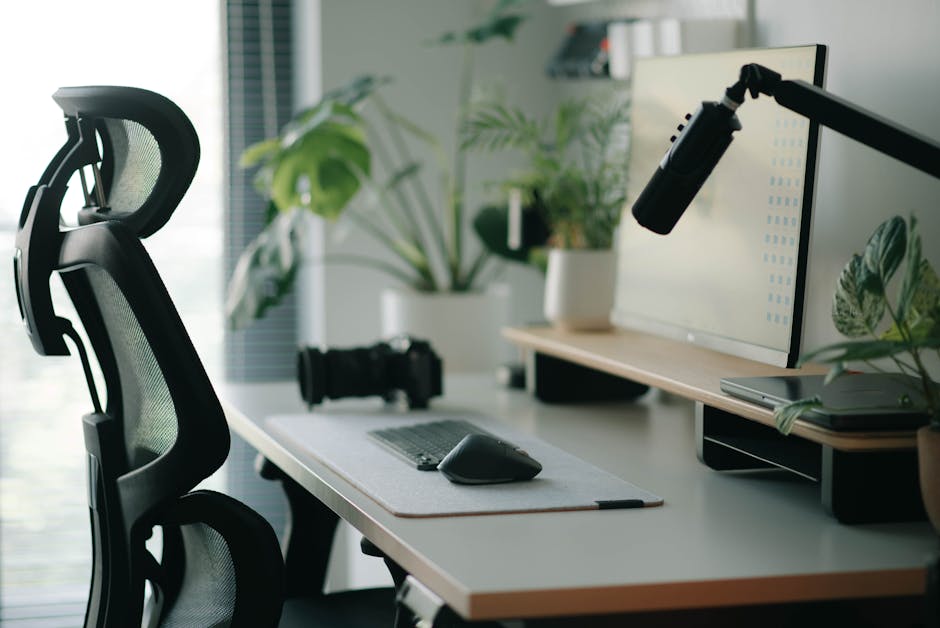
Photo: Alpha En / Pexels
Remote work is the practice of working at or from one's home or another space rather than from an office or workplace.
Found this helpful? Share it!
Our team reviews ergonomic furniture, desk accessories, and productivity tools so you don't have to. Every recommendation is based on real research: customer reviews, expert opinions, and value for money. Learn more about us →
If you're sitting for eight, ten, sometimes twelve hours a day, your chair stops being furniture and starts being equipment. The difference between a decent chair and a genuinely great one shows up around hour four — that's when a poorly supported lower back starts aching, when your shoulders creep toward your ears, and when you find yourself standing up every twenty minutes not because you want to move, but because you can't stand sitting anymore. Long-haul sitting demands a chair engineered for sustained pressure distribution, not just a comfortable first impression in a showroom.
The Herman Miller Aeron (Remastered, Size B with fully adjustable arms and PostureFit SL) remains the benchmark for people who sit for a living, and the reasoning is specific rather than sentimental.
Look for a chair with adjustable lumbar support that can be customized to match your spine's natural curve, since one-size-fits-all lumbar designs often fail to provide adequate support during extended sitting sessions. Test the seat depth and width in person if possible, as a seat that's too deep will put pressure on the back of your knees, while one that's too shallow won't properly support your thighs during long work hours.
The 8Z Pellicle mesh is the standout for long-hour use: it's tensioned in eight distinct zones, firmer under the sit bones and more yielding under the thighs, so pressure never concentrates in one spot the way it does on foam that slowly compresses over a workday. Because it's suspension rather than cushion, there's no "bottoming out" at hour five — the support you have at 9am is the support you have at 6pm.
The PostureFit SL backrest is the other reason it earns the pick. Instead of a single lumbar pad, it uses two independently adjustable pads — one supporting the sacrum, one the lumbar curve — which is what actually keeps your pelvis from rolling backward into a slump. That pelvic tilt is the root cause of most end-of-day lower back pain, and addressing it at the sacrum is more effective than pushing on the lumbar spine alone.
It also comes in three sizes (A, B, C) rather than one-size-fits-most, has a 12-year warranty covering the mesh, pneumatic cylinder, and tilt mechanism, and has a decades-long parts supply chain — meaning a chair you buy today is genuinely repairable in 2035. For a piece of equipment you'll use 2,000 hours a year, that math works out.
Long-hour sitting fails in two ways: pressure and posture drift. Pressure failure is the numbness and hot spots that come from concentrated load on the sit bones and the underside of the thighs — foam handles this well initially, then compresses and stops distributing. The Aeron's zoned suspension doesn't compress, so the load map stays consistent throughout the day. That's why people who've owned one for five years report the same comfort they had in month one, provided they've kept it adjusted.
Posture drift is the slower problem. Over a long day, fatigue causes your pelvis to tilt back and your spine to round into a C-shape, which loads the discs and strains the muscles along your back. PostureFit SL intervenes early by stabilizing the sacrum before the slump can start, and the weight-calibrated tilt tension means the recline actually supports you rather than dumping you back or fighting you forward. Combine that with a forward-tilt option for deep-focus work, and you get a chair that supports a full rotation of postures — which is what your body actually wants across ten hours, rather than one "correct" position held rigidly.
If you're logging long hours at a desk, treat your chair as the single highest-leverage purchase in your workspace — it does more for your day than a second monitor or a faster laptop ever will. Take a look at our full sizing guide and adjustment walkthrough before you buy, and if you can, sit in one for at least thirty minutes before committing.
Look for chairs with adjustable lumbar support, seat height adjustment, and armrests to maintain proper spinal alignment during long work sessions. The seat should have adequate cushioning (at least 3-4 inches of high-density foam) and recline functionality to reduce pressure on your lower back and allow position changes throughout the day.
Quality ergonomic chairs typically range from $300-$1,200, with $500-$800 being the sweet spot for features that prevent long-term back pain and discomfort. Investing in a good chair now prevents costly healthcare issues later, making it worth budgeting for.
A proper ergonomic chair significantly reduces back pain by supporting your spine's natural curve and distributing weight evenly, but it works best combined with good posture and regular movement breaks. No chair alone will fix back pain caused by poor habits—you'll still need to stretch, adjust your desk height, and take standing breaks every 30-60 minutes.
Ergonomic office chairs prioritize lumbar support and prolonged comfort with adjustable features designed for stationary work, while gaming chairs focus on style and side bolsters for active movement. For 8+ hour workdays, ergonomic chairs are better as gaming chairs often lack proper lower back support and become uncomfortable after extended sitting.
As an Amazon Associate I earn from qualifying purchases.
← Back to All Reviews| Retailer | Price Range | Shipping | Link |
|---|---|---|---|
| Amazon | Check Current Price | Free (Prime) | View on Amazon → |
| Walmart | Check Site | Free over $35 | Search → |
| Target | Check Site | Free over $35 | Search → |
Prices may vary. Click through to each retailer for current pricing.