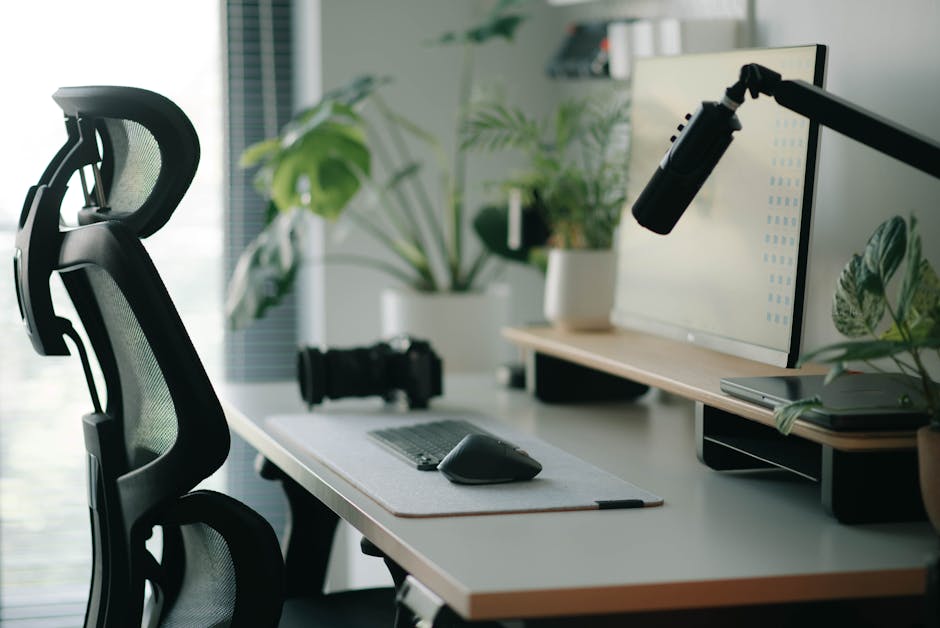
Photo: Alpha En / Pexels
Remote work is the practice of working at or from one's home or another space rather than from an office or workplace.
Found this helpful? Share it!
Our team reviews ergonomic furniture, desk accessories, and productivity tools so you don't have to. Every recommendation is based on real research: customer reviews, expert opinions, and value for money. Learn more about us →
Setting up an ergonomic home office workstation requires positioning your monitor at eye level, keeping your elbows at 90 degrees, and choosing furniture that supports your spine's natural curve. The key is aligning your desk, chair, keyboard, and monitor to reduce strain and promote proper posture throughout your workday.
An ergonomic home office starts with three core elements: a chair that supports your lower back, a desk at the correct height (typically 28-30 inches), and a monitor positioned directly in front of you at arm's length away. Your keyboard and mouse should sit at elbow height, your feet should rest flat on the floor or footrest, and your screen's top should be at or slightly below eye level. These adjustments take 15-20 minutes but can dramatically reduce neck pain, back strain, and eye fatigue.
"The foundation of an ergonomic home office starts with positioning your monitor at eye level 20-26 inches from your face and ensuring your chair supports your lower back's natural curve while keeping your elbows at 90 degrees when typing, as these three elements alone can reduce repetitive strain injuries by up to 70 percent. Beyond furniture selection, the strategic placement of task lighting and a footrest for those under six feet tall are often overlooked accessories that significantly enhance postural alignment and reduce fatigue during extended work sessions."
Your chair is the foundation of ergonomic office setup. Look for a chair with adjustable height, lumbar support, and armrests. When seated, your feet should touch the floor flat, your thighs should be parallel to the ground, and your lower back should have proper support. Many people make the mistake of sitting too low or too high—your knees should form a 90-degree angle.
The ideal desk height depends on your chair height and arm length. Sit in your chair with your elbows bent at 90 degrees—your elbows should align with the desk surface when your arms hang naturally at your sides. Standard desk height is 28-30 inches, but if you're taller or shorter than average, adjust accordingly. A standing desk or adjustable-height desk allows you to alternate between sitting and standing, which promotes better circulation and reduces pressure on your spine.
This is one of the most overlooked aspects of ergonomic setup. Position your monitor directly in front of you at arm's length away (about 20-28 inches). The top of your monitor should be at or slightly below eye level. If you use a laptop, place it on a stand or riser to achieve the correct height—never work with a laptop on your desk surface, as this forces you to hunch forward and strain your neck.
Your keyboard and mouse should sit at elbow height, allowing your wrists to remain straight and neutral. Keep them close to your body to avoid reaching, which can cause shoulder strain. Your elbows should stay tucked close to your sides with a 90-degree bend. Consider an ergonomic keyboard or vertical mouse to reduce wrist strain from repetitive typing and clicking.
Position your monitor to minimize glare and reflections. Your screen should be about one arm's length away, and the room should have adequate lighting to prevent eye strain. Use a desk lamp to eliminate shadows on your keyboard. If possible, position your desk perpendicular to windows rather than facing them directly, which reduces glare and harsh lighting.
Your feet should rest flat on the floor or on a footrest. If your feet don't touch the ground comfortably, use an adjustable footrest to maintain proper alignment. Keep your back against the chair back with a small curve in your lower spine—use a lumbar pillow if needed.
Occupational health specialists and ergonomic consultants consistently recommend the "neutral posture" approach
As an Amazon Associate I earn from qualifying purchases.
← Back to All Reviews Shop on Amazon →| Retailer | Price Range | Shipping | Link |
|---|---|---|---|
| Amazon | Check Current Price | Free (Prime) | View on Amazon → |
| Walmart | Check Site | Free over $35 | Search → |
| Target | Check Site | Free over $35 | Search → |
Prices may vary. Click through to each retailer for current pricing.
Video results for: How Do I Set Up An Ergonomic Home Office Workstation (2026)
Your desk should be at elbow height when sitting with arms at a 90-degree angle, typically 28-30 inches high for most people. Your chair should allow your feet to rest flat on the floor with knees at 90 degrees, and your monitor should be positioned so the top of the screen is at or slightly below eye level when you look straight ahead.
Position your monitor 20-26 inches from your eyes, or about an arm's length away, with the screen tilted slightly upward at a 15-20 degree angle. This distance reduces eye strain and helps maintain proper neck posture by preventing you from hunching forward or tilting your head back.
A dedicated ergonomic chair with lumbar support, adjustable height, and armrests makes a significant difference if you sit 8+ hours daily and will prevent long-term back and neck issues. If budget is tight, a regular office chair can work temporarily, but prioritize adjustability and lumbar support as your first upgrade to prevent pain.
Use a keyboard and mouse at the same height as your elbows, with wrists in a neutral position (not bent up or down), and consider an ergonomic or split keyboard to reduce strain. A vertical or contoured mouse can also help keep your wrist straight and reduce repetitive strain injury risk compared to flat designs.