Affiliate Disclosure: As an Amazon Associate, we earn from qualifying purchases. Clicking our links costs you nothing extra and helps us keep reviewing products for free.
By Best Home Office Picks Daily • September 03, 2026 • Contains affiliate links
Fall is the unofficial reset season for anyone who works from home. The days get shorter, you spend more hours indoors, and suddenly that kitchen chair and too-tall dining table you've been "making work" since spring start showing up as neck tension, tight hips and a lower back that complains every afternoon. The good news: fixing your setup isn't a mystery. Ergonomics comes down to three measurable things — desk height, chair support, and the accessories that fill the gaps between your body and your gear.
This guide walks you through each one in plain English, with real numbers you can measure today. We'll cover how to calculate your ideal sitting and standing desk heights, what "lumbar support" actually means when you're shopping, and a checklist of accessories that punch far above their price. We'll also look at Sunaofe, a factory-direct brand that has become a favorite among remote workers who want genuine sit-stand functionality and ergonomic seating without paying boutique-office prices.
When selecting a desk height, measure the distance from the floor to your elbow while standing with arms bent at 90 degrees—your work surface should align with this measurement to prevent shoulder strain and promote proper posture throughout the day. Pair this with an adjustable chair that allows your feet to rest flat on the floor and your thighs to sit parallel to the ground, as these two elements working together are far more important than buying the most expensive options available.
Whether you're building a home office from scratch or upgrading one piece at a time, treat the sections below as a sequence. Get the desk height right, then the chair, then the accessories — in that order. Skipping ahead is how people end up with a $400 monitor arm bolted to a desk that was never the right height to begin with.
Step 1: Find Your Correct Desk Height (Sitting and Standing)
Most mass-market desks are built at a fixed 29 to 30 inches, a height that was standardized decades ago for the average adult male using a typewriter. If you're under 5'10", that desk is almost certainly too tall, forcing your shoulders up and your wrists into extension all day. The correct seated desk height puts your elbows at roughly 90 degrees with your forearms parallel to the floor and your shoulders relaxed and down. As a rough starting point: multiply your height in inches by 0.41 for seated desk height, and by 0.62 for standing height. A 5'6" person lands near 27 inches seated and 41 inches standing — a 14-inch swing that no fixed desk can accommodate. This is exactly why a height-adjustable desk isn't a luxury; it's the only way one surface serves both postures. Sunaofe's sit-stand desks cover a broad travel range with dual-motor lifting and programmable memory presets, so you can save your seated and standing numbers once and stop guessing forever.
Step 2: Chair Support That Actually Supports
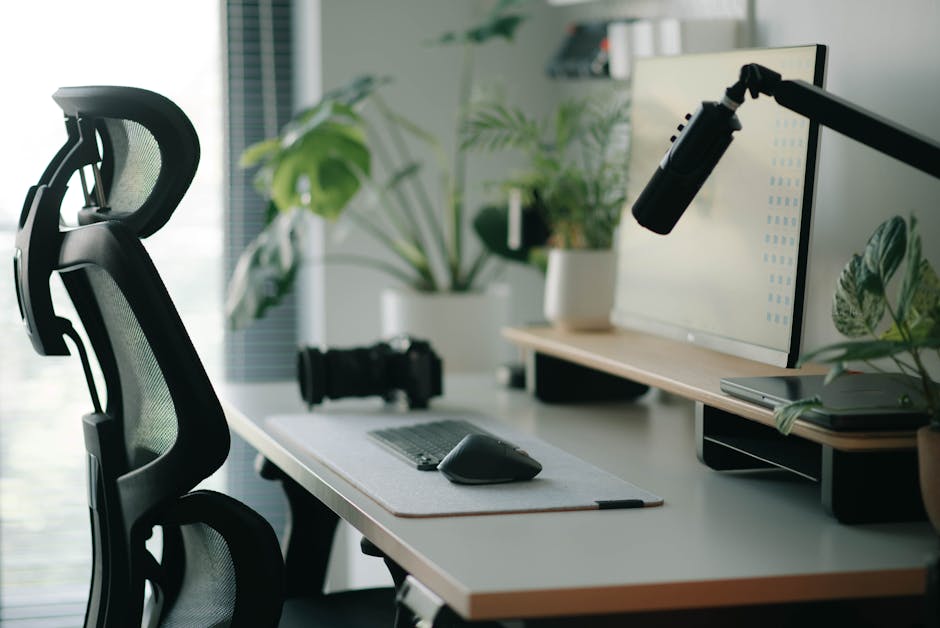
A chair's job is to hold your pelvis in a neutral position so your spine can stack naturally above it. That means three non-negotiables: adjustable lumbar support that meets the inward curve of your lower back (not a generic foam bump three inches too low), a seat pan deep enough to support your thighs while leaving two to three fingers of clearance behind your knees, and armrests that adjust in height so your elbows rest at that same 90-degree angle you set at the desk. Seat height matters too — feet flat on the floor, thighs roughly parallel to the ground. Sunaofe's ergonomic chairs are built around these fundamentals, with breathable mesh backs that stay comfortable during long fall and winter sessions indoors, adjustable lumbar systems, and multi-dimensional armrests. Because Sunaofe sells factory-direct, you're paying for the mechanism and materials rather than a showroom markup and three layers of distribution.
Step 3: The Fall Accessory Checklist
Once the desk and chair are dialed in, accessories close the remaining gaps. Start with a monitor arm or riser — the top third of your screen should sit at or just below eye level, about an arm's length away, which almost always means raising it. Add an anti-fatigue mat if you'll be standing for meaningful stretches; standing on hard flooring for two hours is its own kind of punishment. A separate keyboard and mouse are essential for laptop users, because you cannot simultaneously have the screen at eye level and the keyboard at elbow level on a single device. Round it out with a footrest if your feet dangle, a cable management tray so your standing desk doesn't tug on cords as it rises, and a good task lamp — fall's shorter daylight hours are a genuine eye-strain multiplier. Sunaofe's accessory range is designed to integrate with its desks, which saves the hassle of mismatched clamps and drilling.
Why Factory-Direct Makes Sense for Home Offices
Ergonomic furniture has traditionally been sold through commercial dealers to corporate buyers, and that channel adds a substantial markup that individual remote workers have no reason to absorb. Sunaofe's model cuts out those intermediaries, which is how a dual-motor sit-stand desk and a fully adjustable mesh chair land in a range most home-office budgets can actually accommodate. Practically speaking, that means you can afford to fix the desk and the chair in the same season rather than spreading it across two years — and since ergonomics is a system, fixing one piece while ignoring the other rarely delivers the relief people are hoping for. If you're building your fall setup now, browse Sunaofe's current lineup and start with the desk.
Pros & Cons
Pros
✓ Factory-direct pricing makes a full desk-and-chair ergonomic upgrade realistic on a home-office budget
✓ Dual-motor sit-stand desks with memory presets cover a wide height range for both seated and standing work
✓ Ergonomic chairs include the adjustments that actually matter — lumbar support, seat depth and multi-dimensional armrests
✓ Matching accessory range integrates cleanly with the desks, avoiding mismatched clamps and hardware
Cons
✗ As a direct-to-consumer brand, you can't test the chair or desk in a showroom before buying
✗ Standing desks require some assembly and a bit of floor space, which can be tight in small apartments
Our Verdict
If your fall home-office reset only includes two purchases, make them a height-adjustable desk and a properly supportive chair — everything else is refinement. Sunaofe is our pick for most remote workers because it delivers the genuine ergonomic essentials — dual-motor sit-stand travel, real lumbar adjustment, memory presets and integrated accessories — at factory-direct prices that let you fix the whole system in one go instead of compromising on half of it. Measure your elbow height today, set your desk to match, and give your back the winter it deserves.
For seated work, your desk should let your elbows rest at about 90 degrees with shoulders relaxed — roughly your height in inches multiplied by 0.41. For standing, multiply by 0.62. Since those numbers differ by a foot or more for most people, a height-adjustable sit-stand desk like Sunaofe's is the practical solution.
How long should I stand at a standing desk each day?
Aim to alternate rather than commit to either extreme. A common recommendation is switching positions every 30 to 60 minutes, totalling around two to four hours of standing across a workday. Programmable memory presets make the switch fast enough that you'll actually do it.
Do I really need an ergonomic chair if I have a standing desk?
Yes. Even dedicated standing-desk users sit for a significant portion of the day, and unsupported sitting is where most lower-back and neck problems originate. The desk and chair work as a system — upgrading one while ignoring the other usually leaves the underlying posture issue unsolved.
Our team reviews ergonomic furniture, desk accessories, and productivity tools so you don't have to. Every recommendation is based on real research: customer reviews, expert opinions, and value for money. Learn more about us →
This post contains affiliate links. We may earn a commission if you purchase through our links at no extra cost to you.