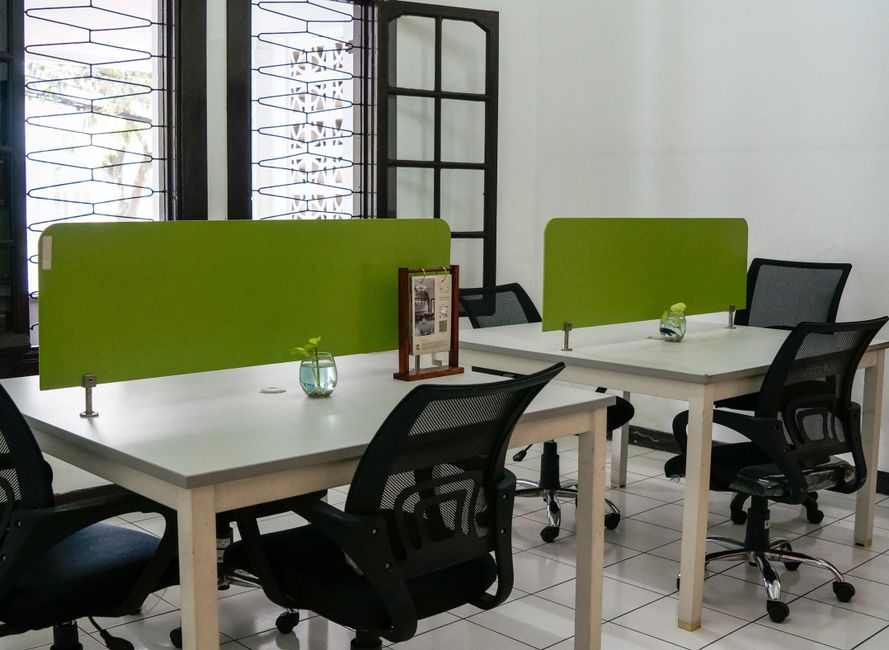
Photo: Firman Marek_Brew / Pexels
Remote work is the practice of working at or from one's home or another space rather than from an office or workplace.
Remote work has made home office noise control less of a luxury and more of a necessity. But the market has fragmented: acoustic desk partitions and dividers sound identical, yet they solve different problems depending on your workspace, noise sources, and budget constraints.
This guide cuts through the terminology confusion and compares the actual solutions available in 2026—from premium foam screens to freestanding dividers to clamp-mounted barriers. We've analyzed real product specifications, NRC ratings, installation compatibility, and the measurable trade-offs between them, so you can pick the right solution without wasting money on something that won't fit your desk or block the noise you actually hear.
Check the NRC (Noise Reduction Coefficient) rating on acoustic partitions before purchasing—look for ratings of 0.7 or higher to ensure they'll actually absorb sound rather than just deflect it, and measure your desk depth and ceiling height to confirm the partition won't create awkward gaps that compromise its sound-blocking effectiveness.
Purpose-built foam panels designed for direct mounting to desk surfaces, typically achieving NRC (Noise Reduction Coefficient) ratings of 0.7–0.9. These screens use high-density acoustic foam materials and are engineered to absorb mid-to-high frequency noise (voices, keyboard clatter, speaker feedback) rather than deflect it. Installation usually involves clamps or adhesive strips, making them compatible with most desk materials as long as weight capacity is verified beforehand.
The trade-off: maximum sound absorption but requires desk surface commitment and reduces usable workspace footprint directly at your working area.
Best for: Users in open floor plans with moderate budget ($150–$400 range) who need reliable NRC performance and don't plan to move offices frequently.
Standalone barriers with independent base support that sit behind or beside your desk without mounting hardware. These typically cover 12–15 inches above desk surface and come in modular configurations (single panel vs. multi-panel L-shapes). They're easier to relocate than mounted screens and work on any desk type, but stability depends entirely on base design—and improper placement can reduce acoustic effectiveness by up to 30% according to installation guidance.
Advantage: zero installation friction and flexibility. Disadvantage: takes up floor footprint and may require repositioning if desk setup changes.
Best for: Renters, hot-desk setups, or anyone who moves offices every 1–2 years and needs a no-damage solution.
Partitions that attach via C-clamps or universal mounting brackets to desk edges, positioning sound-absorbing material 12–18 inches above seated ear level. This approach optimizes the "coverage zone" where overhead noise (voices, overhead speakers, roommate chatter) actually travels, and mounting is fully reversible—no adhesive, no holes. Material compatibility is critical: clamps won't work reliably on glass tops without protective padding, and weight capacity varies significantly by clamp design.
These deliver targeted absorption in the most critical acoustic zone but require compatible desk geometry and aren't suitable for sit-stand desks with frequent height adjustments.
Best for: Fixed-position desk setups where mounting hardware won't damage the surface and you want maximum acoustic precision without workspace loss.
Partition sets that combine multiple panels in L-shape or wraparound configurations to address noise from multiple directions—particularly useful in open floor plans where distractions come from more than one source. These can be configured with adhesive strips, clamps, or freestanding bases depending on the specific system. Coverage area flexibility allows you to customize which desk zones are protected based on your primary noise sources.
Trade-off: modularity adds complexity to setup and installation; some configurations may require multiple mounting methods on the same desk.
Best for: Rooms with noise from multiple directions (neighbors on two sides, open kitchen adjacent to desk) where single-panel solutions provide incomplete coverage.
Premium Acoustic Foam Screens win for consistent NRC performance and permanent setups where you need lab-tested sound absorption and don't plan to relocate. They're the most researched option and deliver reliable decibel reduction when positioned correctly at ear level.
Freestanding dividers win for flexibility and rental situations—they move with you, require no installation skill, and zero surface damage. The trade-off is floor footprint and marginally lower acoustic precision compared to mounted systems.
Clamp-mounted barriers win for optimized coverage zones—they position sound-absorbing material exactly where overhead noise travels without consuming desk workspace. But they only work on rigid desks with compatible geometry; sit-stand desks or glass tops add complexity.
Modular multi-panel systems win when noise comes from multiple directions (open floor plans, family homes with activity on two sides of your desk). Single-panel solutions often fail in these environments because they only block one noise vector.
The real decision: measure your desk depth, identify whether your primary noise sources are overhead (voices, speakers) or lateral (hallway chatter, roommates), and verify your desk material is compatible with your mounting choice. NRC rating matters less than installation precision—a properly mounted 0.7-rated screen outperforms an incorrectly positioned 0.9-rated one.
Functionally, there's minimal difference—the terms are used interchangeably. 'Partition' often implies a mounted screen, while 'divider' suggests a freestanding barrier, but product specs matter far more than terminology. What matters: NRC rating, height above your seated ear level (12–18 inches optimal), coverage area, and whether it's mounted or freestanding.
NRC 0.7+ produces noticeable sound absorption—you'll hear a clear difference in voice clarity and background noise. Below 0.7, the acoustic benefit becomes marginal. However, NRC ratings only describe absorption; positioning matters equally. A properly positioned 0.7-rated screen at ear level outperforms a 0.9-rated screen positioned too low or too far away.
Partially. Acoustic partitions absorb sound they encounter directly—voices and speaker output in your workspace. They do not block sound traveling through walls, doors, or air ducts. For cross-room noise (partner's meeting in adjacent room), you need sound-blocking solutions (mass, air-sealing) rather than sound-absorbing ones. A partition helps contain your own sound and reduces reflections of incoming noise, but it won't eliminate it.
Mounted screens reduce usable desk area by 8–12 inches of depth (footprint of the panel base plus clamps). Freestanding dividers don't consume desk area but require 12–24 inches of floor space behind or beside your desk. Clamp-mounted barriers use minimal desktop footprint (mostly vertical) but need compatible desk edges. Measure your current setup before purchasing.
Freestanding dividers work fine as long as the desk height range doesn't shift the partition's effectiveness zone beyond your ear level when seated. Clamp-mounted systems are problematic with sit-stand desks because clamping position changes with height adjustments, altering acoustic coverage. Adhesive-mounted screens work but may fail if desk materials expand/contract with temperature changes in adjustable bases.
Test positioning by adjusting height incrementally: if voices become noticeably clearer when you raise the partition 2–3 inches, it was positioned too low. Optimal positioning places the top edge 12–18 inches above your seated eye level and 12–15 inches above your desk surface. If it's below these benchmarks, you're losing up to 30% of acoustic effectiveness regardless of material quality.
Found this helpful? Share it!
Our team reviews ergonomic furniture, desk accessories, and productivity tools so you don't have to. Every recommendation is based on real research: customer reviews, expert opinions, and value for money. Learn more about us →
This post contains affiliate links. We may earn a commission if you purchase through our links at no extra cost to you.
← Back to Best Home Office Picks Daily| Retailer | Price Range | Shipping | Link |
|---|---|---|---|
| Amazon | Check Current Price | Free (Prime) | View on Amazon → |
| Walmart | Check Site | Free over $35 | Search → |
| Target | Check Site | Free over $35 | Search → |
Prices may vary. Click through to each retailer for current pricing.