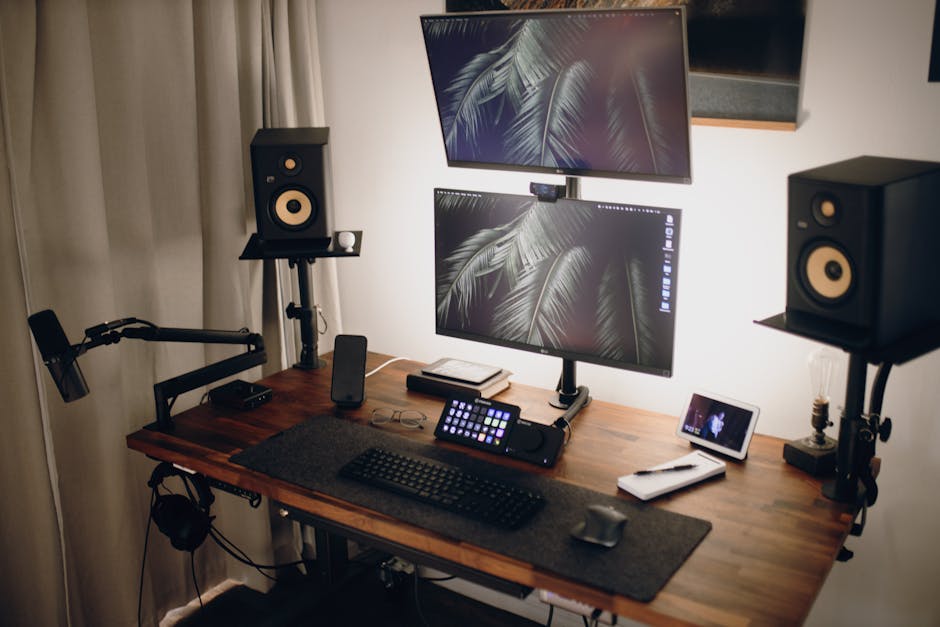
Photo: Josh Sorenson / Pexels
Remote work is the practice of working at or from one's home or another space rather than from an office or workplace.
Found this helpful? Share it!
Our team reviews ergonomic furniture, desk accessories, and productivity tools so you don't have to. Every recommendation is based on real research: customer reviews, expert opinions, and value for money. Learn more about us →
If you've invested in a standing desk, you're already taking a major step toward better ergonomics and productivity. But here's the thing: without the right keyboard tray, you're likely undoing all that good work by hunching forward or straining your wrists. A quality keyboard tray transforms your standing desk from a back-pain waiting room into a genuinely comfortable workspace where you can actually focus on your work instead of your posture.
The Humanscale Keyboard System 6G is the gold standard for standing desk users because it does exactly what a keyboard tray should do without any fuss. It features a smooth ball-bearing mechanism that makes height adjustments feel buttery-smooth, a generous mousing surface that extends to either side, and an adjustable tilt platform that keeps your wrists in perfect alignment whether you're at 28 inches or 48 inches high. Unlike cheaper alternatives, this tray won't sag, rattle, or require constant readjustment—it maintains its position reliably throughout your workday.
When selecting a keyboard tray for your standing desk, measure the exact depth of your desk and ensure the tray's arm extension reaches comfortably to your seated or standing position without forcing your shoulders forward or elbows away from your body. Look for models with independent mouse platforms and adjustable height/tilt angles rather than fixed positions, since your optimal ergonomic setup may differ significantly between sitting and standing throughout the day.
Standing desks create a unique ergonomic challenge that most keyboard trays don't address: the distance between your body and your keyboard changes dramatically when you switch positions. A fixed keyboard tray works fine when you're always sitting, but at a standing desk, it either sits too high when you're standing (causing shoulder elevation) or too low when you're sitting (forcing you to hunch). The Humanscale system solves this by letting you make micro-adjustments without effort, so you'll actually use it every time you change positions instead of just leaving it wherever it lands.
Beyond ergonomics, the psychological benefit of a smooth, responsive tray shouldn't be underestimated. When your accessories feel cheap or resistant, you unconsciously stop using them and revert to poor habits. A high-quality keyboard tray that glides effortlessly becomes part of your workflow—you'll naturally adjust it, and that consistent micro-movement throughout the day is exactly what standing desks are designed to provide. You get the health benefits of position-switching without the postural compromises that derail most standing desk experiments.
The right keyboard tray transforms your standing desk from an ambitious purchase gathering dust to a genuine ergonom
Most keyboard trays range from 24-30 inches wide to fit standard desks, but measure your desk depth first—you'll need at least 10-12 inches of clearance from the desk edge for comfortable typing. Check your monitor arm and CPU placement to ensure the tray won't interfere with other equipment or cables. A built-in mouse pad attachment keeps your mouse at the same ergonomic height as your keyboard, reducing shoulder strain and preventing you from reaching across your desk. Most quality keyboard trays have this feature, and it's worth prioritizing since separate mouse pads often sit too high or too low compared to your keyboard. Basic keyboard trays start around $30-50, mid-range options with good adjustability run $80-150, and premium ergonomic trays with advanced features cost $150-300+. Investing in a quality tray reduces wrist pain and improves posture, making it one of the best ROI accessories for remote workers. You can use a regular tray, but standing desk-specific trays have wider height adjustment ranges (typically 10-20 inches) to accommodate both sitting and standing positions. Regular desk trays often max out at 4-6 inches of adjustment, which won't provide proper ergonomics when you're standing.Frequently Asked Questions
What size keyboard tray do I need for my standing desk?
Should I get a keyboard tray with a mouse pad included?
How much does an ergonomic keyboard tray for a standing desk cost?
Can I use a regular keyboard tray on a standing desk or do I need a special one?
As an Amazon Associate I earn from qualifying purchases.
← Back to All Reviews| Retailer | Price Range | Shipping | Link |
|---|---|---|---|
| Amazon | Check Current Price | Free (Prime) | View on Amazon → |
| Walmart | Check Site | Free over $35 | Search → |
| Target | Check Site | Free over $35 | Search → |
Prices may vary. Click through to each retailer for current pricing.